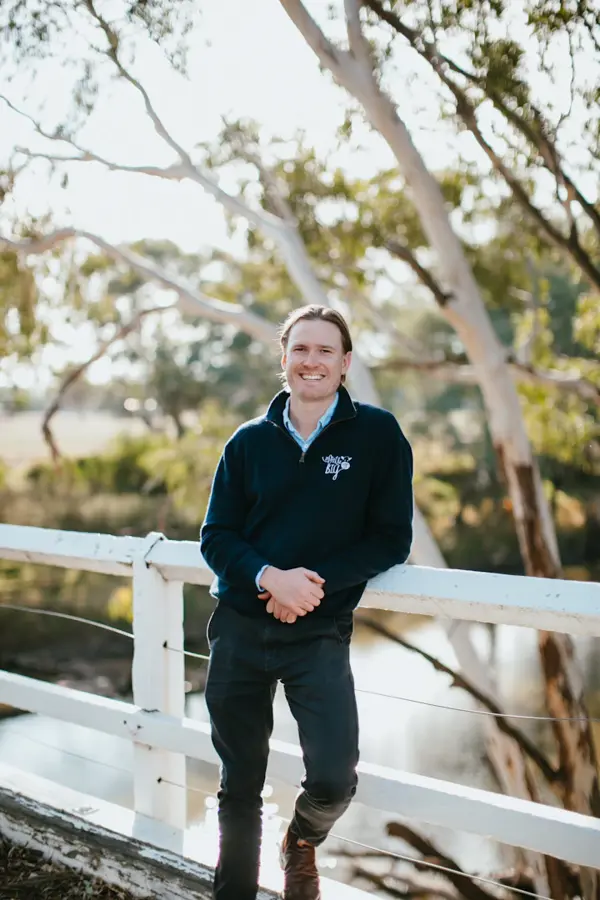
Alice Jorgensen

Hedging Your Bets: Why the Winter Feed Gap Needs a Patchwork, Not a Replacement
Could temperate perennial pasture take the place of oats in a northern NSW beef system? Beef producer and agronomist Alice Jorgensen, supported by Woolworths, who runs Boonda Ag with her husband Dane at Myall Creek near Inverell, used her 2025 Nuffield Scholarship to find out, travelling to Uruguay, Argentina and the United States. Her answer: not entirely, but it can play a bigger role than it does now.
“Annual fodder cropping of predominantly winter cereals in this area works well, achieves excellent weight gain and is agronomically a relatively simple system. However, the cost of this production system is increasing, and soil fertility is declining, so I wanted to investigate how perennial pastures can fill this gap,” Alice says.
Her research found forage cereals and temperate perennial pastures are broadly comparable in feed quality at the vegetative stage. On Alice’s indicative figures, a forage cereal costs around $622/ha a year for about 12 tonnes of dry matter per hectare (roughly 5.2 cents/kg), while a temperate perennial pasture averages around $230/ha a year over a five-year life for about 6.5 tonnes (roughly 3.5 cents/kg). Cheaper feed, but a little over half as much of it.
“The conclusion I draw for my family’s farm and for other farmers in the region, is that in order to respond to a variable climate in a transitional zone, we need to have a patchwork system feedbase. I do not believe it is viable to replace annual fodder cropping entirely with temperate pastures for the winter feed gap, as I still see a fit for having both in the system,” Alice says.
Some of the clearest proof came from home. After a very dry start to 2026, no planting rain fell on Alice’s farm until mid-May. Rested Phalaris paddocks provided quality feed as little as three weeks later, while the forage oats took eight weeks to be ready to graze.
Alice’s advice to producers in transitional environments is to build a patchwork of annual fodder crops alongside sub-tropical and temperate pastures, adopt adaptive rather than prescriptive grazing, and adjust persistence expectations, as producers in Uruguay and Argentina do by rotating pastures back to cropping every three to four years. For advisors, her message is: manage expectations but push the boundaries.
Investor Information:
As 'The Fresh Food People', Woolworths Group relies on our farmers, suppliers, and regional teams to deliver quality produce to Australians.
Woolworths has partnered with Nuffield Australia for over a decade and is proud to contribute to the personal development of exceptional leaders - helping to grow the capability of the Australian agricultural sector. Nuffield scholars support Woolworths' efforts to create a better tomorrow by harnessing opportunities that can have a positive impact on our teams, our planet, our products and the communities we serve.
Website: www.woolworthsgroup.com.au